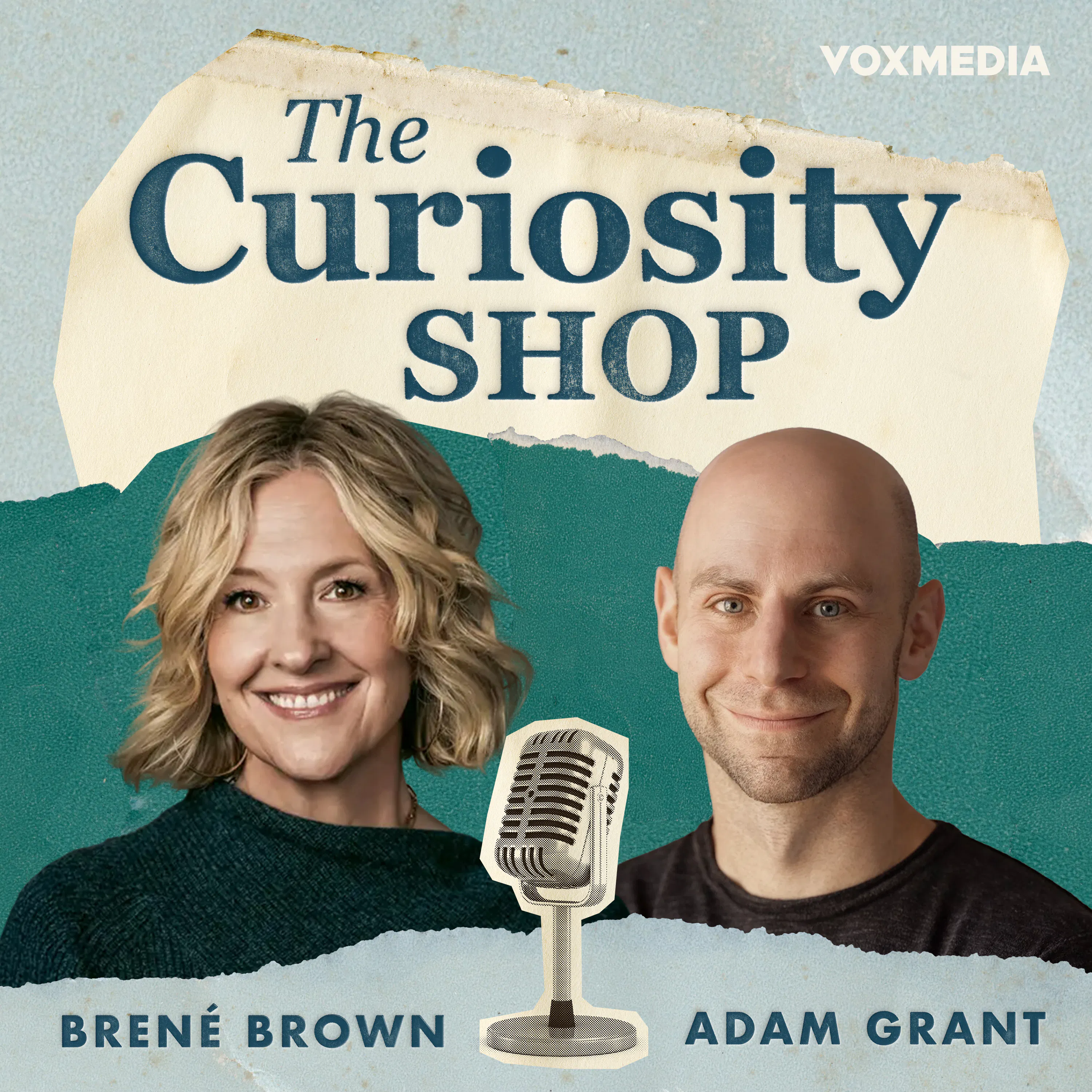
The Curiosity Shop with Brené Brown and Adam Grant
The Emotion Few Talk About, But Many Feel
Research professor Brené Brown and organizational psychologist Adam Grant are partnering on a new weekly podcast grounded in an unflinching commitment to learning and unlearning. At a time when public discourse rewards certainty over inquiry, The Curiosity Shop features two of the world's most sought-after experts on connection, change, and leadership making the case for slowing down, asking better questions, and embracing informed complexity over easy answers. Bringing together their left and right brain sensibilities — she’s a qualitative researcher; he’s a quantitative researcher — they explore some of the defining questions of our time, unpack the research reshaping how we live, lead, and love, and dive deep into the ideas, evidence, and cultural moments intriguing them the most. New episodes drop every Thursday. Part of the Vox Media Podcast Network.
Show Notes
Tap timecodes to jump
From classrooms and locker rooms to workplaces and social media, Adam and Brené trace how shame and humiliation are used to control behavior and even fuel violence. They explore what causes shame, why our self-protective responses backfire, and how we can handle it more effectively. They also unpack the messy overlap between imposter syndrome and cultural pressures toward self-doubt.
You can find The Curiosity Shop on YouTube and Instagram (@thecuriosityshop).
Chapter Titles + Timestamps:
Introduction
The One, Two, Threes of Shame
The New Research on Humiliation
What Is Humiliation?
Why Don’t People Outgrow Shame?
How to Help People Out of Shame?
Reconnecting Your Prefrontal Cortex Post-Shame
How Does Shame Relate to Imposter Syndrome?
Biggest Takeaways About Shame, Guilt, Humiliation, and Embarrassment
Why Feelings of Guilt May Signal Leadership Potential - Marina Krakovsky, 2012, Insights by Stanford Business (Introducing the work of Schaumberg)
Unwanted identities: A key variable in shame-anger links and gender differences in shame - Ferguson et al., Sex Roles
Humiliation: Causes, correlates, and consequences - Elison & Harter, 2007, from The self‑conscious emotions: Theory and research
Healing Humiliation: From Reaction to Creative Action - Hartling & Linder, 2016, Journal of Counseling & Development Shame and Humiliation: From Isolation to Relational Transformation - Hartling et al., Stone Center for Developmental Services and Studies
Strengthening resilience in a risky world: It’s all about relationships - Hartling, 2003, Women & Therapy
Stop Telling Women They Have Imposter Syndrome - Ruchika Tulshyan & Jodi-Ann Burey, 2021, Harvard Business Review
How imposter syndrome can be your superpower - MIT Sloan Office Of Communications, 2025 (Introducing the work of Basima Tewfik)
Unmasking the Impostor - MIT Sloan Office of Communications, 2025 (Tewfik, Debunking 4 myths)
Listening to shame, Brené Brown, 2012, TED
The Power of Vulnerability, Brené Brown, 2011, TED
Learn more about your ad choices. Visit podcastchoices.com/adchoices
This episode is not processed yet. Sign in to queue the transcript and make it useful for search and Q&A.
Sign in to queue transcript (1 credit)
Free to start
Skim the episode first,
Skim the episode first,
then decide if it is worth listening.
Sign up with Google in one click. 10 transcript credits included. No card needed.
Google sign-in · No credit card · 10 free transcript credits